
Taj Mahal History & Facts (Untold Secrets You Didn’t Know – 2026)
Introduction
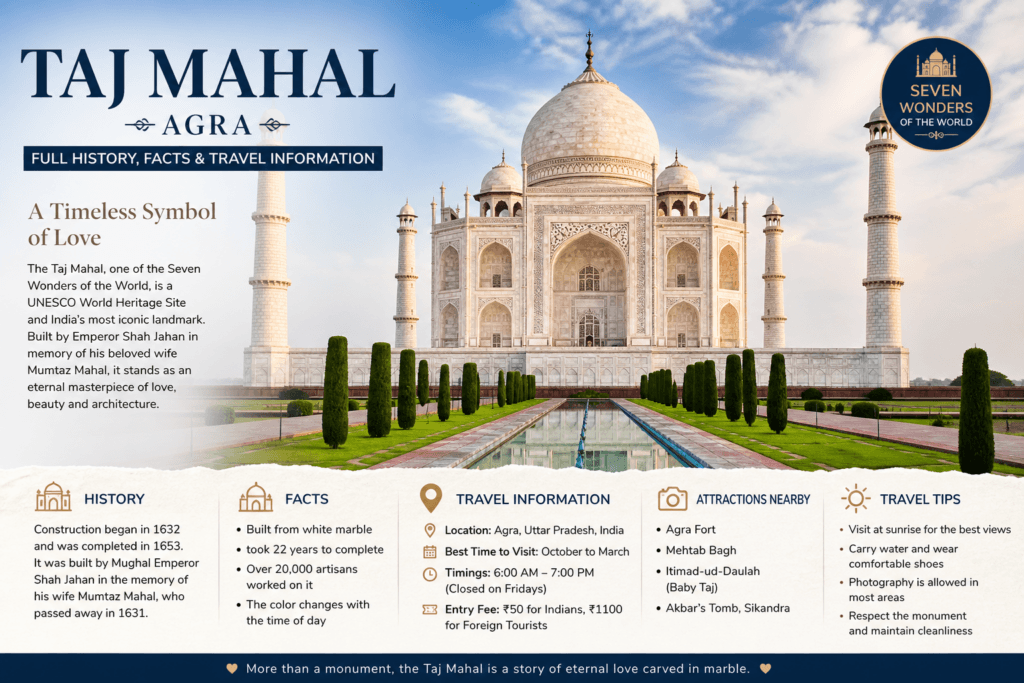
The Taj Mahal is one of the most iconic monuments in the world and stands as a proud symbol of India’s rich history, culture, and architectural brilliance. Located in Agra, Uttar Pradesh, on the banks of the Yamuna River, the Taj Mahal attracts millions of visitors every year from every corner of the globe. Its magnificent white marble structure, beautiful gardens, detailed carvings, and emotional story make it one of the most admired buildings ever created.
The monument is not simply a tourist attraction. It represents eternal love, dedication, artistic perfection, and the grand vision of the Mughal Empire. The Taj Mahal is recognized as a UNESCO World Heritage Site and is also listed among the New Seven Wonders of the World. Even after hundreds of years, the beauty and elegance of the Taj Mahal continue to amaze historians, architects, photographers, travelers, and artists.
- Taj Mahal History & Facts (Untold Secrets You Didn’t Know – 2026)
- Introduction
- The Historical Background of the Taj Mahal
- Who Designed the Taj Mahal?
- Architecture of the Taj Mahal
- How the Taj Mahal Was Built
- Distance from Delhi to the Taj Mahal
- Best Time to Visit the Taj Mahal
- Entry Fees and Visiting Information
- Interesting Facts About the Taj Mahal
- 6. Millions of Visitors
- 7. Optical Illusion
- Cultural and Global Importance
- Tourist Tips for Visiting the Taj Mahal
- Nearby Attractions in Agra
- Why the Taj Mahal Remains Timeless
- Conclusion
The Historical Background of the Taj Mahal
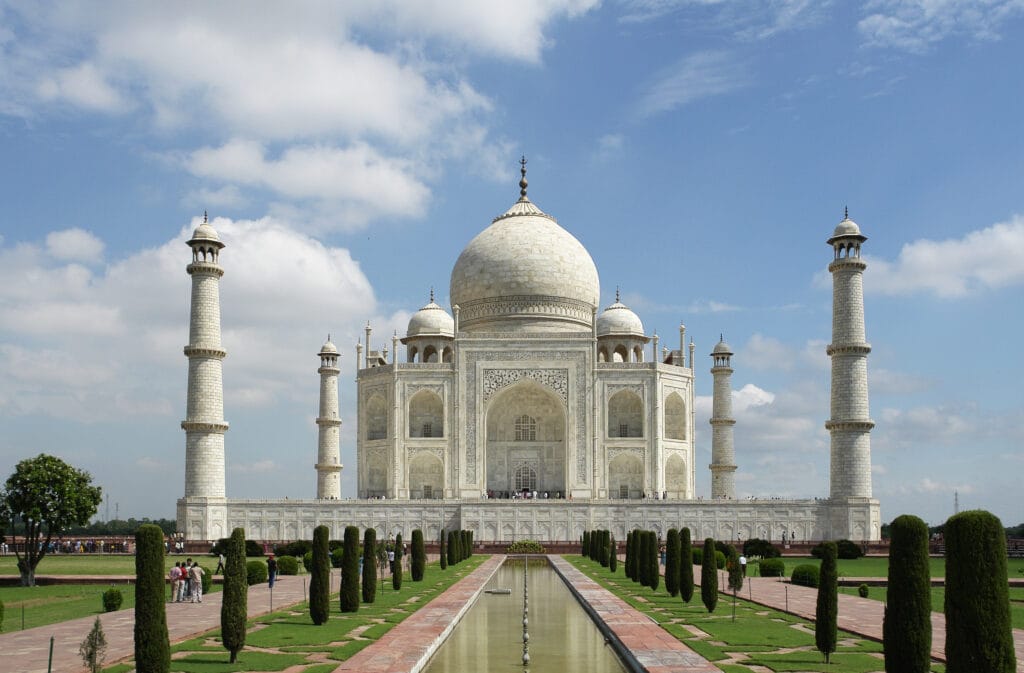
The history of the Taj Mahal begins during the golden age of the Mughal Empire in the 17th century. Mughal Emperor Shah Jahan, who ruled from 1628 to 1658, was known for his interest in architecture, luxury, and art. Among all his wives, he shared a very close bond with Mumtaz Mahal, whose real name was Arjumand Banu Begum.
Mumtaz Mahal was not only Shah Jahan’s wife but also his trusted companion and advisor. She accompanied him on military campaigns and played an important role in his personal and political life. In 1631, while giving birth to their fourteenth child in Burhanpur, Mumtaz Mahal died. Her death deeply affected Shah Jahan, and according to historical accounts, he remained in mourning for a long period.
To honor her memory and express his eternal love, Shah Jahan decided to build a monument unlike anything the world had ever seen. Construction of the Taj Mahal began in 1632 and continued for nearly 22 years. Thousands of workers, artists, engineers, and craftsmen worked tirelessly to complete the project.
The monument was finally completed around 1653 and became one of the finest examples of Mughal architecture ever built.
Who Designed the Taj Mahal?
The chief architect believed to have designed the Mahal was Ustad Ahmad Lahori, a highly respected architect of the Mughal court. However, the monument was not the work of one individual alone. A large team of architects, engineers, calligraphers, stone carvers, inlay artists, and craftsmen contributed to its construction.
Experts and artisans came from various regions including:
- India
- Persia
- Turkey
- Central Asia
- Afghanistan
The Taj Mahal reflects a beautiful combination of Persian, Islamic, Turkish, and Indian architectural styles. This blend created a structure that appears perfectly balanced, elegant, and timeless.
Architecture of the Taj Mahal
The architecture of the Taj Mahal is one of the main reasons behind its global fame. Every detail of the monument was carefully planned to create harmony, beauty, and symmetry. The entire complex spreads across approximately 42 acres and includes gardens, fountains, pathways, mosques, gateways, and several supporting buildings.
The White Marble Exterior
The most striking feature of the Taj Mahal is its brilliant white marble exterior. The marble used for construction was brought from Makrana in Rajasthan, which is famous for producing high-quality marble.
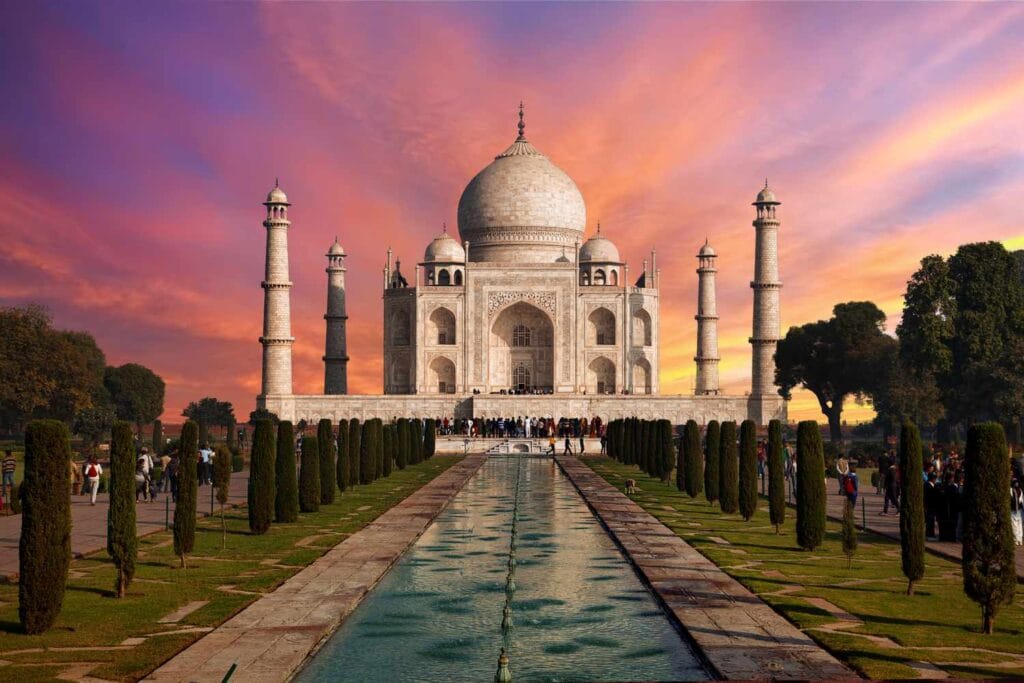
One of the fascinating characteristics of the Taj Mahal is how its color changes throughout the day. During sunrise, the monument appears slightly pink. In bright daylight, it shines brilliantly white, while under moonlight it appears golden or silver-blue. This magical visual effect adds to its charm and beauty.
The Main Dome
At the center of the Taj Mahal stands a massive onion-shaped dome. The dome rises approximately 73 meters above the ground and dominates the skyline of Agra. Around the main dome are four smaller domes that enhance the structure’s symmetry.
The dome symbolizes heaven in Islamic architecture and gives the monument its royal and graceful appearance.
The Four Minarets
At each corner of the main platform stands a tall minaret. These four minarets are slightly tilted outward. Engineers designed them this way intentionally so that in the event of an earthquake, the minarets would fall away from the main tomb rather than damaging it.
This demonstrates the advanced engineering knowledge used during the construction.
Intricate Carvings and Decoration
The walls of the Taj Mahal are covered with intricate decorative work that showcases extraordinary craftsmanship. The monument includes:
- Floral carvings
- Arabic calligraphy from the Quran
- Geometric patterns
- Precious stone inlay work
The decorative technique known as “Pietra Dura” was widely used.
The Interior Chamber
Inside the Taj Mahal are the symbolic tombs of Mumtaz Mahal and Shah Jahan. The actual graves are located in a lower chamber beneath the main hall.
The interior is decorated with marble screens, carvings, and detailed artistic work. Even the smallest details inside the monument reflect luxury and perfection.
How the Taj Mahal Was Built
The construction of the Taj Mahal was one of the most ambitious engineering projects of its time. Building such a massive marble monument in the 17th century required extraordinary planning, labor, and resources.
Materials Used in Construction
Materials were collected from different parts of Asia and transported to Agra.
Some important materials included:
- White marble from Rajasthan
- Jasper from Punjab
- Jade and crystal from China
- Turquoise from Tibet
- Lapis lazuli from Afghanistan
- Sapphire from Sri Lanka
- Carnelian from Arabia
More than 28 varieties of precious and semi-precious stones were used for decoration.
Workforce and Labor
Approximately 20,000 workers participated in the construction. The workforce included:
- Stone cutters
- Sculptors
- Painters
- Calligraphers
- Designers
- Engineers
- Laborers
Many skilled craftsmen were brought from Persia and Central Asia.
Transportation System
At that time, modern machinery did not exist. Heavy materials were transported using carts, camels, and more than 1,000 elephants.
Large ramps were built to move marble blocks to higher levels of the structure.
Foundation Engineering
Because the Taj Mahal was built near the Yamuna River, creating a strong foundation was extremely important. Engineers built deep wells filled with stone and mortar to support the structure.
Wooden foundations were also used beneath the monument to provide stability.
Construction Techniques
Workers used pulley systems, scaffolding, and manual lifting techniques to place massive marble stones accurately.
The detailed inlay work and carvings required years of patient craftsmanship.
Distance from Delhi to the Taj Mahal
The Taj Mahal is located in Agra, approximately 230 kilometers from Delhi. Because of the short distance, Agra is one of the most popular weekend travel destinations for tourists visiting Delhi.
Traveling by Road
Traveling by road is one of the most convenient ways to reach Agra.
- Distance: Around 230 kilometers
- Travel Time: Approximately 3 to 4 hours
- Best Route: Yamuna Expressway
The Yamuna Expressway is a modern highway connecting Delhi and Agra. The smooth roads make the journey comfortable and fast.
Traveling by Train
Agra is well connected to Delhi through several high-speed trains.
Popular trains include:
- Gatimaan Express
- Shatabdi Express
- Taj Express
Travel time by train usually ranges between 2 and 3 hours.
Traveling by Air
Although Agra has a small airport, most tourists prefer trains or road travel because they are more affordable and convenient.
Best Time to Visit the Taj Mahal
The best time to visit the Taj Mahal is during the winter season from October to March. During this period, the weather remains pleasant and comfortable for sightseeing.
Summers in Agra can become extremely hot, with temperatures crossing 40°C. Therefore, winter months are considered ideal.
Best Time of Day to Visit
Sunrise Visit
Early morning visits offer breathtaking sunrise views and fewer crowds.
Sunset Visit
The monument looks stunning during sunset when golden light reflects on the white marble.
Full Moon Nights
On selected full moon nights, special night viewing sessions are available. The Taj Mahal under moonlight creates a magical and unforgettable experience.
Entry Fees and Visiting Information
The Taj Mahal remains open from sunrise to sunset every day except Friday.
On Fridays, the monument is closed for regular visitors because prayers are conducted in the mosque inside the complex.
Ticket Categories
Ticket prices differ for:
- Indian tourists
- Foreign tourists
- SAARC visitors
- Children
Online ticket booking is recommended because it helps avoid long waiting lines.
Interesting Facts About the Taj Mahal
The Taj Mahal is surrounded by fascinating stories and facts that increase its popularity.
1. UNESCO World Heritage Site
The Taj Mahal was declared a UNESCO World Heritage Site in 1983.
2. One of the Seven Wonders of the World
It is recognized globally as one of the New Seven Wonders of the World.
3. Color-Changing Marble
The marble changes color depending on the time of day and weather conditions.
4. Perfect Symmetry
Almost every part of the Taj Mahal is perfectly symmetrical.
5. Shah Jahan’s Tomb
Originally, only Mumtaz Mahal’s tomb was planned. Shah Jahan’s tomb was added later beside hers.
6. Millions of Visitors
More than seven million people visit the Taj Mahal every year.
7. Optical Illusion
The monument appears larger when viewed from far away and smaller when approached closely.
Cultural and Global Importance
The Taj Mahal is much more than an architectural masterpiece. It is considered a universal symbol of love and devotion.
For centuries, poets, artists, filmmakers, and writers have drawn inspiration from the monument. It represents:
- Eternal love
- Mughal artistic excellence
- India’s rich heritage
- Advanced engineering
- Cultural beauty
The monument also contributes greatly to India’s tourism industry and global cultural identity.
Tourist Tips for Visiting the Taj Mahal
If you are planning to visit, these tips can help improve your experience.
- Visit early in the morning to avoid heavy crowds.
- Wear comfortable footwear because the complex is large.
- Carry water during summer visits.
- Keep your camera ready for photography.
- Hire a licensed guide for better historical understanding.
- Avoid carrying prohibited items.
- Book tickets online in advance.
Nearby Attractions in Agra
The Agra offers several historical attractions besides the Taj Mahal.
Agra Fort
Agra Fort is a massive red sandstone fort built by Mughal Emperor Akbar. It served as the royal residence of Mughal rulers.
Mehtab Bagh
Mehtab Bagh is a beautiful garden located across the Yamuna River. It offers a breathtaking rear view of the Taj Mahal.
Fatehpur Sikri
Located near Agra, Fatehpur Sikri was once the capital of the Mughal Empire. It contains magnificent palaces and historical structures.
Itimad-ud-Daulah
Known as the “Baby Taj,” this tomb inspired many design elements later used in the Taj Mahal.
Why the Taj Mahal Remains Timeless
Even after more than 350 years, the Taj Mahal continues to stand as one of the world’s greatest architectural achievements. Its emotional story, flawless symmetry, detailed artwork, and peaceful surroundings create a unique experience for every visitor.
The monument reminds humanity that love, art, and creativity can produce timeless beauty that survives for centuries.
Conclusion
The Taj Mahal is not just a monument made of marble; it is a masterpiece filled with emotion, history, and artistic brilliance. Built by Emperor Shah Jahan in memory of Mumtaz Mahal, it remains a powerful symbol of eternal love.
From its grand architecture and detailed carvings to its fascinating history and engineering techniques, every aspect of the Taj Mahal tells a remarkable story. Millions of travelers continue to visit Agra every year to witness this wonder with their own eyes.
Whether you are passionate about history, architecture, photography, or travel, the Taj Mahal offers an unforgettable experience. It remains one of India’s greatest treasures and one of the most admired monuments ever built in human history.
If you ever visit India, seeing the Taj Mahal in person should definitely be part of your journey.
- Best Travel Credit Cards in India 2026 (Free Flights + Lounge Access)
- 10 Best Places to Visit in the USA for First-Time Travelers (2026 Guide)
- 2 Hidden Historical Places in the USA Most Tourists Miss: Exploring Cahokia Mounds & St. Augustine (Complete Travel Guide)
- 5 Best Places for Solo Travel in India – (Safe & Budget-Friendly 2026)
- 4 Days in Bali Itinerary for Indian Couples (Romantic + Budget 2026 Guide)